Short answer: In Germany, influencers must disclose a post as advertising as soon as they receive payment or a similar consideration for it, which includes free products, trips, discounts, or commissions. Since the 2022 reform of the German Unfair Competition Act, this is governed by Section 5a(4) UWG. The safest option is the word "Werbung" (advertising) or "Anzeige" (ad) right at the beginning of the post, clearly visible and recognizable without scrolling.
Ad disclosure in influencer marketing is the clearly visible notice that a social media post serves a commercial purpose, for example "Werbung" or "Anzeige". It is meant to prevent followers from mistaking a paid recommendation for a personal, neutral opinion. If the commercial purpose is concealed, this is called surreptitious advertising.
The obligation applies to all formats: Instagram posts, reels, and stories, TikTok videos, YouTube videos, blog articles, podcasts, and LinkedIn posts. It applies to influencers and content creators of every size; there is no fixed follower threshold. According to the consumer advice center of North Rhine-Westphalia (Verbraucherzentrale NRW) (as of February 2025), what matters is whether someone acts commercially and functions as a multiplier.
Since May 28, 2022, Section 5a(4) UWG explicitly regulates when a post in favor of a third-party company counts as advertising: when the person acting receives, or is promised, payment or a similar consideration for it. What was once a "new draft law" has become applicable law, and the legal situation today is much clearer than it was a few years ago.
The reform follows three rulings by the German Federal Court of Justice (BGH) of September 9, 2021. Among other things, the BGH ruled that an influencer who had received no consideration from the manufacturers shown did not have to label her posts, while a paid post without disclosure was unlawful (summary by ROSE & PARTNER).
This article is not legal advice. For individual cases, such as contracts with exclusivity or your own brands, a legal review is worthwhile.
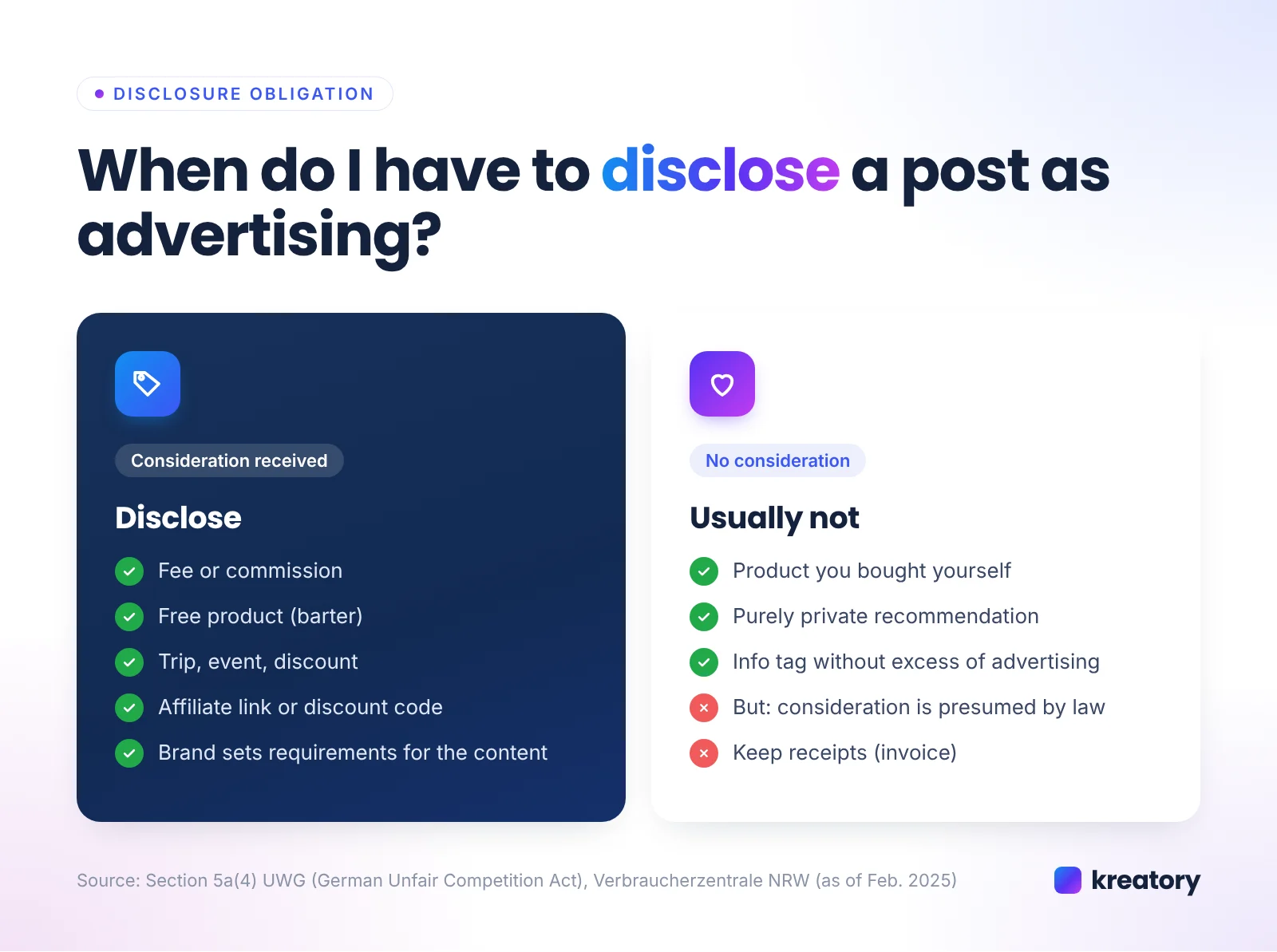
Influencers must disclose as soon as a company gives or promises them something for a post. This applies regardless of whether the consideration is money or in kind.
If a creator shows a product they bought themselves out of their own motivation, there is generally no obligation to disclose. Purely private posts are not affected either. Caution applies to a so-called "excess of advertising" ("werblicher Überschuss"): according to eRecht24, a one-sidedly praising presentation or a link directly to the manufacturer's page, for example, can indicate that it is advertising after all.
If an influencer promotes their own brand or company, disclosure is generally not required under the guidelines of the German media authorities, provided it is clearly recognizable to followers that it is their own business. If that is not obvious, the post should be disclosed.
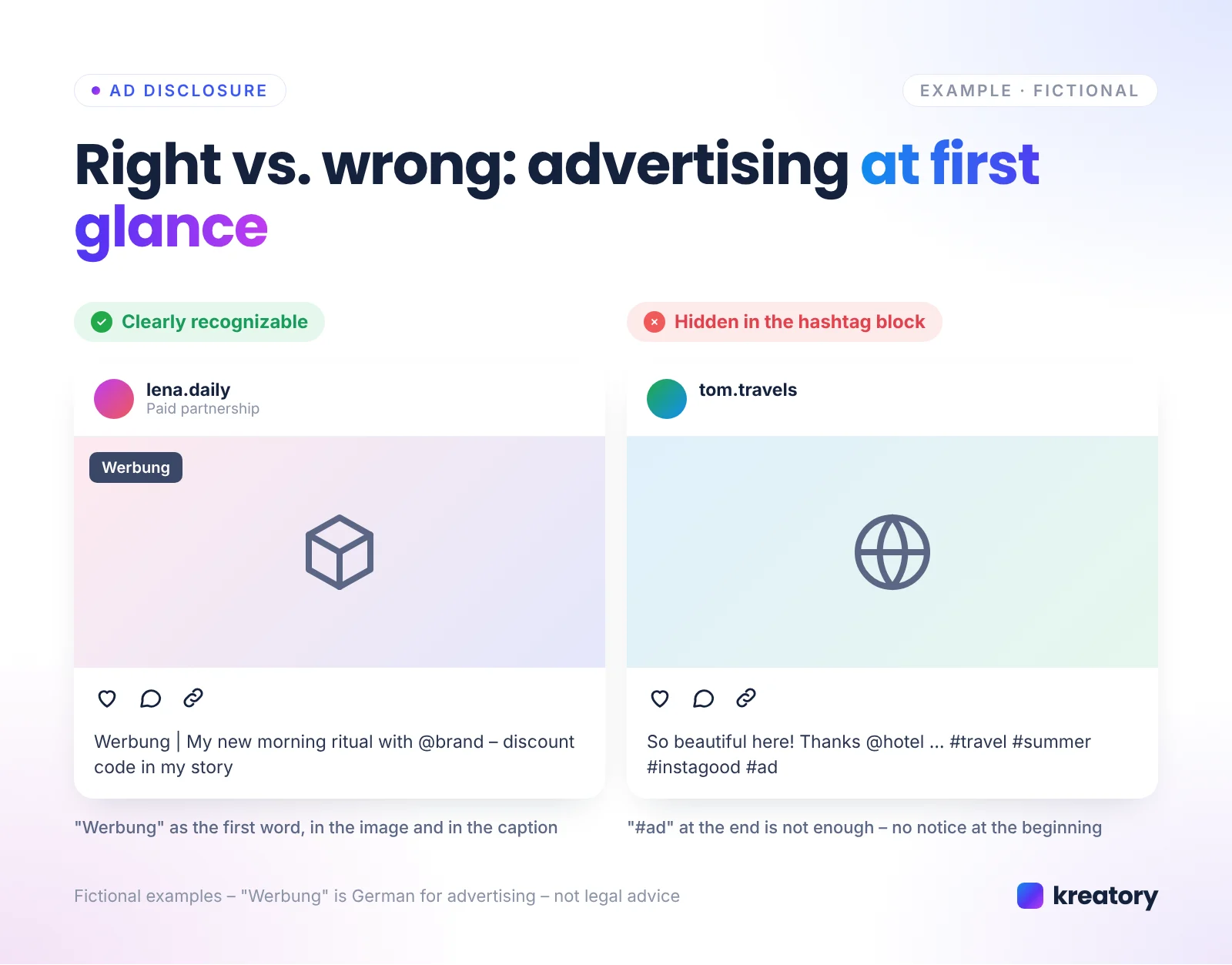
A post is correctly disclosed when its commercial nature is recognizable at first glance. The consumer advice center puts it this way: advertising must be recognizable as such "clearly at the beginning".
According to the guidelines, terms such as "Advertorial", "sponsored by", or abbreviations like "ad" are not sufficient. A blanket notice in the profile ("This account contains advertising") is not enough either; every promotional post must be disclosed individually.
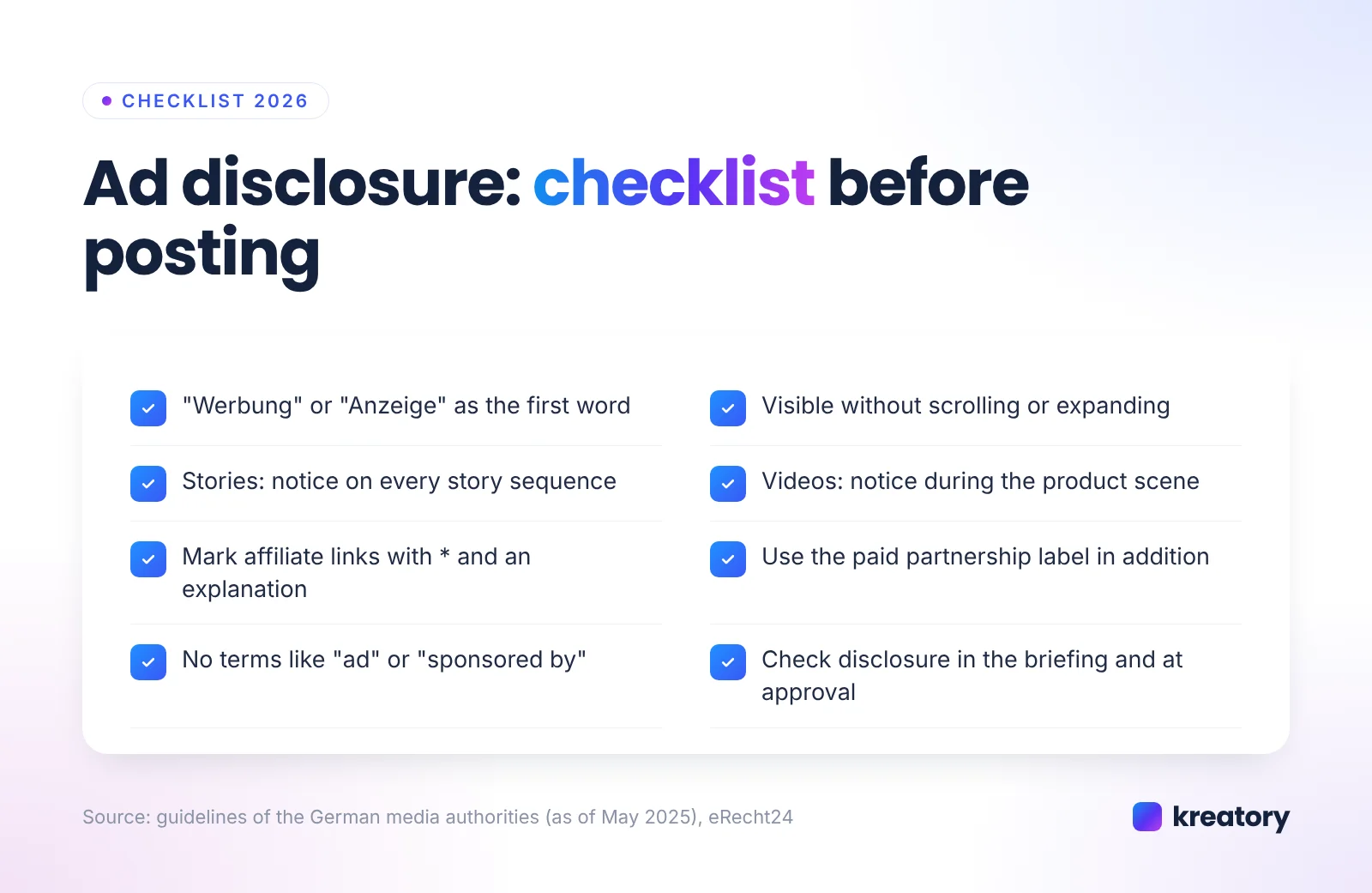
The guidelines of the German media authorities (Medienanstalten) on "ad disclosure in online media" are the most important practical reference for creators in Germany. The State Media Authority of Baden-Württemberg (LFK) refers to the version dated May 2025. The key points by format:
| Format | How to disclose |
|---|---|
| Feed post (image/text) | "Werbung" or "Anzeige" at the beginning of the caption; for image-only posts, also in the image |
| Story | Clearly visible notice on every promotional story sequence |
| Video/reel | If the product is the focus: permanent "Werbung" notice during the video |
| Incidental product placement | Notice such as "contains product placement" at the beginning; for products received free of charge, according to the guidelines, from a value of over 100 euros |
| Affiliate link, discount code | Disclosure in immediate proximity, e.g. with an asterisk (*) and a short explanation |
| Blog article | Notice above or directly below the headline |
The media authorities update their guidelines regularly. Before major campaigns, check the current version at die-medienanstalten.de.
If the disclosure is missing, the post is generally considered unfair under competition law. Possible consequences are cease-and-desist letters (Abmahnungen) from competitors or associations such as the Wettbewerbszentrale, injunctive relief claims, and complaints from the responsible state media authority. On top of that comes the damage to reputation: followers react sensitively when they feel deceived.
Companies are not automatically off the hook either. Anyone commissioning a collaboration should make sure that the disclosure is agreed on and implemented.
Companies should treat ad disclosure as a fixed process step, from briefing to approval. This protects both them and their creators.
On Kreatory, you approve content before it is posted, so you can check the disclosure before a post goes live. Set up a campaign, find suitable creators via AI matching, compare offers, and book with one click. The 90-second demo shows what this looks like in practice.
Want to run influencer campaigns with a clean approval process? Register for free or book a personal demo.
No. In German-language posts, English terms such as "ad" or "sponsored by" are considered insufficient under the media authorities' guidelines. Use "Werbung" or "Anzeige" at the beginning of the post.
Generally yes. A product provided free of charge counts as consideration under Section 5a(4) UWG. So you should disclose barter deals as advertising too.
The platform label is a useful addition. But the media authorities also recommend a clear notice such as "Werbung" at the beginning of the post so that the disclosure is reliably recognizable at first glance.
Yes. For stories, every promotional sequence should carry a clearly visible notice, because users can skip individual slides or jump in directly.
Generally not, as long as no consideration was given and there is no excess of advertising. Since the law presumes consideration, you should keep your purchase receipts.
Primarily the influencer who publishes the post. Depending on the individual case, however, the commissioning company can also be held liable. So regulate the disclosure in the briefing and in the agreement. This article is not legal advice.

👉 Want deep insights into influencer marketing & UGC sourcing and curious about our success stories?📈