
Brands
Influencer Industry Insights
Business

Influencer Marketing Agency vs. Software: Pros & Cons

von David Winker
October 24, 2026
Influencer Marketing Agency vs. Software: Pros & Cons

Short answer: An influencer marketing agency makes sense when you lack in-house expertise, plan large one-off campaigns that need full creative direction, or simply don’t have the bandwidth. Software is usually the better choice when you run campaigns regularly, book many creators, need UGC for ads and want to keep control and data in-house. Plenty of brands combine the two.

Key takeaways

  • Agency = a service covering strategy, creative and execution; software = a tool your own team works with.
  • Agencies bring experience and networks but usually charge a fee or markup.
  • Software scales more cost-effectively but needs your team’s time for decisions and oversight.
  • According to an industry survey, about two-thirds of brands run their programs fully in-house.
  • The right choice depends on campaign volume, budget, expertise and how much control you want.

What’s the core difference between an agency and software?

An influencer marketing agency does the work for you: it develops the strategy, finds creators, negotiates, manages execution and delivers a report. You’re buying expertise and hours.

Influencer marketing software (a platform) gives you the tools: creator database, matching, outreach, booking, content approval, tracking and billing. Your team makes the decisions; the software automates the busywork.

We’ve already covered when an agency is worth it in why it can make sense to use an influencer marketing agency. This article is the head-to-head comparison.

How do brands actually run influencer marketing today?

Influencer Marketing Hub’s 2026 Benchmark Report paints a clear picture: 66.33% of respondents manage their influencer programs entirely in-house, while 10.71% use a hybrid model and another 10.71% rely fully on an agency. The functions most often outsourced are creator discovery and vetting (19.44%) and content production (15.28%).

In other words, many brands bring in help for the most time-consuming steps – exactly the steps modern platforms automate.

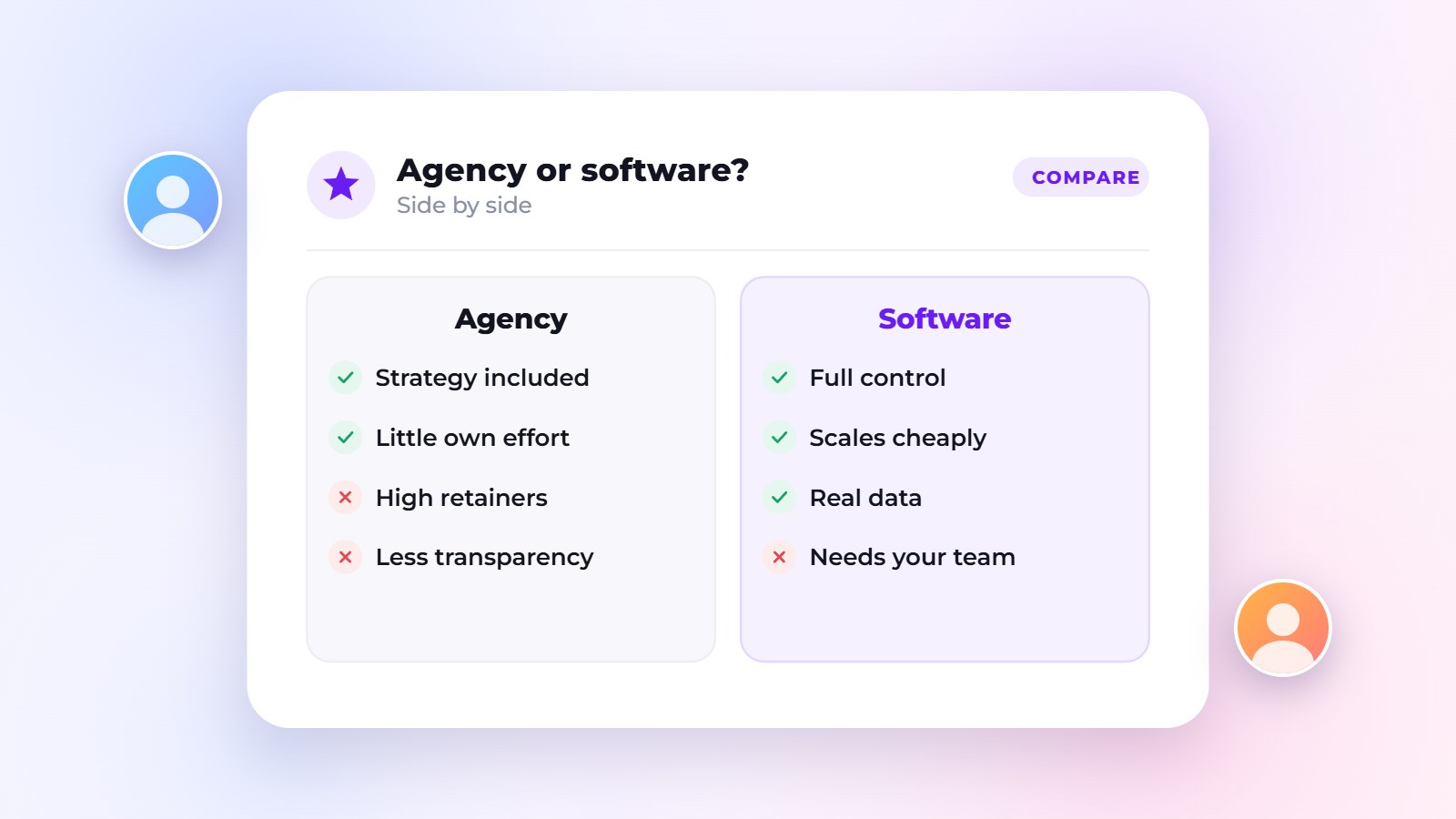
What are the pros and cons of an agency?

Pros:

  • Experience, proven playbooks and an existing creator network
  • Creative concepts and strategic advice from one partner
  • Takes work off your team’s plate, especially for big campaigns
  • One point of contact for everything

Cons:

  • Higher costs through fees, retainers or markups
  • Less visibility into creator pricing and selection
  • Longer feedback loops
  • Know-how and creator relationships often stay with the agency

What are the pros and cons of software?

Pros:

  • Predictable license costs that drop per campaign as you scale
  • Full control over creator selection, briefs and approvals
  • Direct access to data and performance
  • Faster execution with fewer handoffs
  • Know-how and creator relationships stay in your company

Cons:

  • Your team needs time to steer campaigns and make decisions
  • You develop strategy and creative concepts yourself – or buy them in
  • There’s a learning curve for the tool

Agency vs. software at a glance

  • Cost: agency – typically a fee or markup per campaign; software – a monthly license plus creator fees.
  • Control: agency – shared; software – yours.
  • Speed: agency – depends on coordination; software – ready when you are.
  • Scalability: agency – scales with budget; software – scales with automation.
  • Transparency: agency – periodic reports; software – live data.
  • Expertise: agency – built in; software – you build it over time.

How do you compare costs fairly?

A straight price comparison is tricky because the models are built differently. Agencies often bill a monthly retainer, a project fee or a markup on creator fees. With software, you pay a license and pay creators directly.

So compare the total cost per campaign:

  • Agency: fee or markup + creator fees + internal time for coordination and approvals.
  • Software: share of the license + creator fees + internal time for running campaigns.

The more campaigns you run, the more the license spreads out – while agency fees usually recur with every campaign. For what individual creators cost, see our article on influencer marketing costs in 2026.

Which questions should you ask before deciding?

  1. How many campaigns do you plan in the next twelve months?
  2. How many creators do you need per campaign – five or fifty?
  3. Is there someone on your team who can run campaigns, even for a few hours a week?
  4. Do you mainly need reach, or a steady stream of ad creative?
  5. How much do price transparency and direct data access matter to you?
  6. Do you want to build long-term creator relationships yourself?

The more of these you answer with “many,” “yes” or “a lot,” the more likely software is the right fit.

When is an agency the better choice?

  • You’re just getting started and have no influencer marketing experience.
  • You’re planning a big brand campaign with heavy production, events or celebrity partnerships.
  • Your team has no capacity at all – not even for decisions and approvals.
  • You need strategic advice that goes beyond influencer marketing.

When is software the better choice?

  • You run campaigns regularly and want to lower the cost per campaign.
  • You work with lots of nano- and micro-creators or barter deals.
  • You need a steady stream of UGC for paid ads and want to test variations quickly.
  • You want to own your creator relationships and data.
  • You’re an agency yourself and want to run client campaigns more efficiently.

For the criteria that matter when picking a tool, see our guide on how to choose an influencer marketing platform.

Does a hybrid model make sense?

Often, yes. A common setup: strategy and flagship campaigns with outside support, while always-on campaigns and UGC production run in-house on a platform. Many agencies use software themselves to deliver client campaigns efficiently.

The switch works best step by step: start with a manageable campaign on the platform, carry over proven briefs and creators from past work, and build routine in-house. Templates like our briefing templates shorten the learning curve.

Kreatory supports both approaches. As a brand, you run your own campaigns with access to more than 5.4 million creators, AI matching and automated outreach. You can set up a campaign in under 10 minutes; creators send offers, you book with one click, approve content before it’s posted, and get tracking and payouts handled automatically – with Kreatory as your single billing partner. Agencies can use the platform for their clients, too. Learn more about influencer marketing and UGC sourcing with Kreatory, or check the pricing page – plans start at €173 per month. More than 250 brands, including IKEA, LG and MILES, already work with Kreatory; see our success stories.

Not sure which model fits? Let’s look at your goals together in a personal demo – or sign up and try the platform yourself.

FAQ: agency vs. software

Is software always cheaper than an agency?

Not automatically. A license usually costs less than agency fees, but your team invests time instead. If you run campaigns regularly with many creators, software typically pays off faster.

Do I need experience to use influencer software?

It helps, but it’s not required. Good platforms guide you through briefs and campaign setup, and templates like our briefing templates make it easier to get started.

Can agencies use influencer software?

Yes. Many agencies use platforms to find creators faster and run campaigns for multiple clients efficiently.

Who handles contracts and invoices with software?

It depends on the vendor. With Kreatory, billing runs through Kreatory as a single billing partner, and creators are paid automatically.

Can I switch from an agency to software later?

Yes. Many brands start with an agency and gradually bring influencer marketing in-house once processes and expertise are in place.

10 Success Stories for Free

👉 Want deep insights into influencer marketing & UGC sourcing and curious about our success stories?📈

Download 10 success cases for free now 👇
Thank you! Your submission has been received!
Oops! Something went wrong while submitting the form.
This site is protected by reCAPTCHA, and the Google Privacy Policy and Terms of Service apply.

Influencer Marketing & UGC Sourcing