
Short answer: The fastest way to find micro-influencers is an influencer platform that lets you filter by follower count, niche, and engagement, backed up by hashtag research, your own customers, and referrals. Micro-influencers usually have a few thousand to 100,000 followers, a close-knit community, and lower rates than big accounts. What matters most is that their values, audience, and content quality fit your brand.
Micro-influencers are social media creators with a comparatively small but especially engaged community. Unlike mega-influencers with millions of followers, they typically have a few thousand up to a maximum of 100,000 followers. Accounts below that are often called nano-influencers; above it, you are looking at mid-tier or macro-influencers. The boundaries are not uniformly defined.
What makes micro-influencers so valuable is their ability to reach a niche and build a close bond with their followers. Thanks to their manageable follower count, they maintain a personal relationship with their audience, which makes them come across as especially authentic and credible.
In this guide, you will learn why micro-influencers are worth it for brands, which ways there are to find them, and how to tell whether a profile really fits.
Sign up for free on Kreatory now
Micro-influencers combine credibility, niche focus, and fair costs. Mega-influencers bring big reach, but micro-influencers offer a set of advantages of their own.
One of the outstanding advantages is their authenticity. Thanks to their manageable number of followers, they build stronger personal relationships and share content that is perceived as genuine. Their recommendations feel particularly trustworthy to their followers, which in turn strengthens trust in the promoted brand. Micro-influencers come across as relatable, not aloof.
The close relationship also leads to higher engagement on both sides. Since they are not overwhelmed by a huge follower count, they invest more time in personal interaction. This makes your marketing message more likely to be noticed and to spark conversations.
Micro-influencers usually work in a clearly defined subject area and bring a lot of experience and know-how to it. Their community shares these interests. The targeted focus of their content ensures high relevance: you deliver your message precisely to the people who are interested in your products or services. The key is to choose micro-influencers that are a truly precise fit for your campaigns.
Besides being effective, micro-influencers are also a cost-efficient option. Compared to mega-influencers, the cost of a collaboration is often lower, so you reach an engaged audience without blowing your budget. For the price ranges you should expect, see our article on influencer marketing costs.
Finally, micro-influencers offer a high degree of flexibility. Because of their smaller reach, they are more often willing to enter into individual collaborations, for product brands often as a barter deal (product instead of budget). They are open to creative ideas and build campaigns together with you that excite your target audience.
There are six proven ways to find micro-influencers. The fastest is a platform with filters; the other ways complement your search. Ideally, you already know the niche well and know what to look for.

For an overview of every method, including for larger accounts, read our guide on how to find influencers.
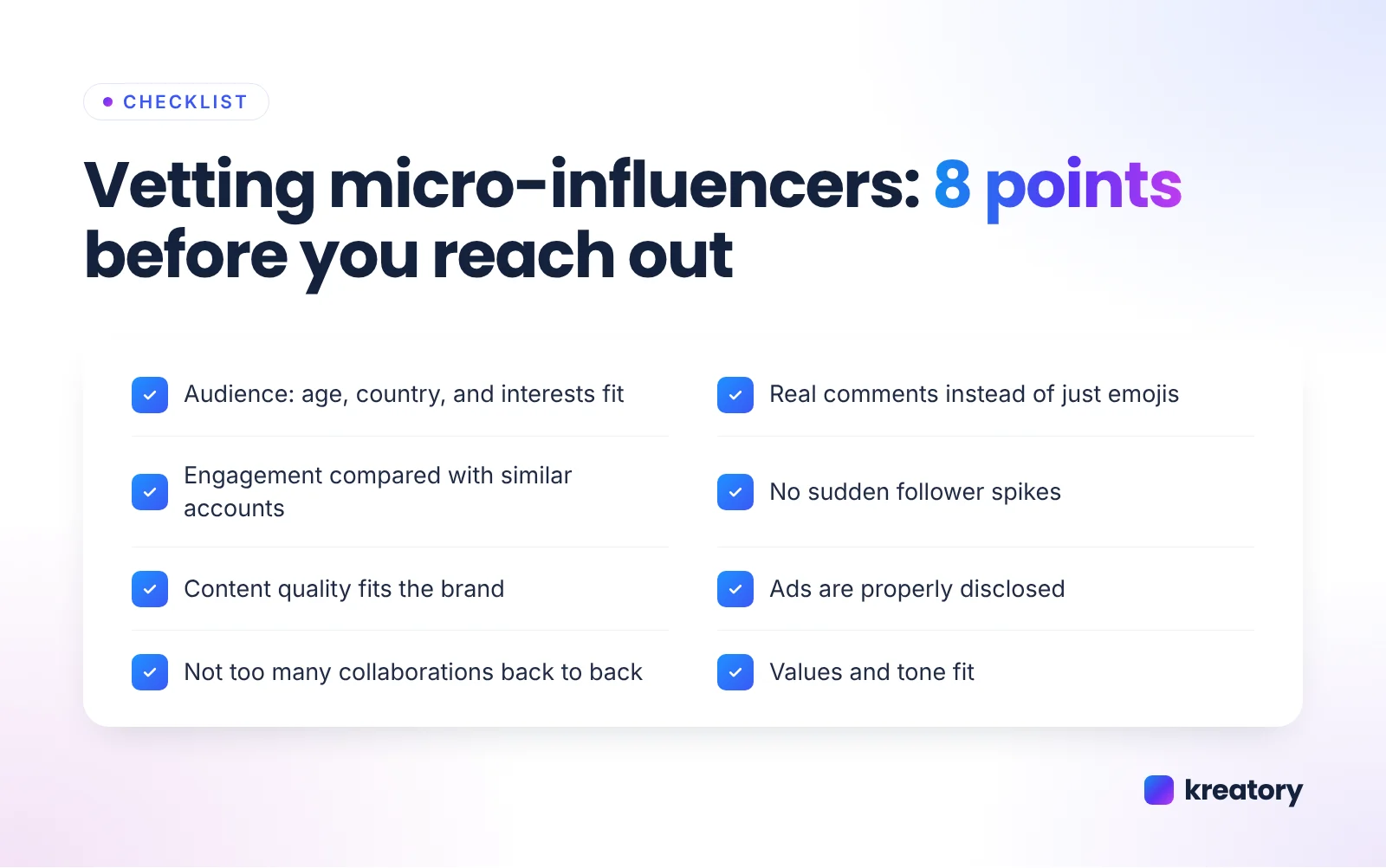
A micro-influencer is a fit when their community matches your target audience and genuinely interacts with them. Follower count alone says little. Before any collaboration, check whether values and audience match your brand, and look at the quality and authenticity of the content as well as the engagement and feedback from followers.
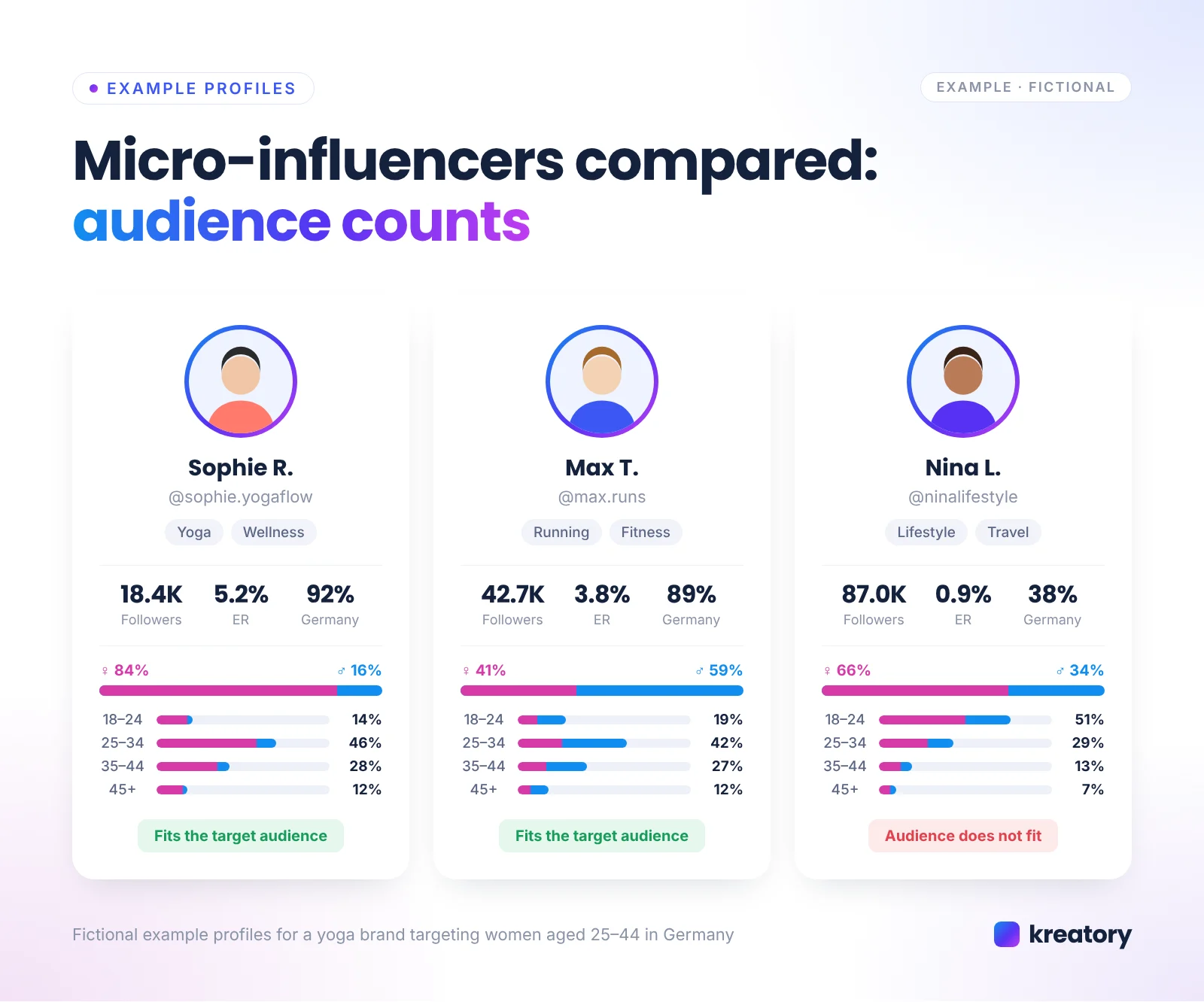
The example shows: the account with the most followers is not automatically the best choice. If only a small share of the community is in Germany, where the brand sells, or engagement is low, you will barely reach your target audience. Our article on KPIs for choosing the right influencers explains which metrics to check in detail. You will find further selection criteria in How to find the right influencer.
You spot fake followers mainly through mismatches between follower count, growth, and interaction. Smaller accounts can have bought followers or likes too. Watch for these warning signs:
The most reliable data comes directly from the connected account rather than screenshots. On Kreatory, DigiKits® show verified media kits with data from the creators' connected Instagram accounts.
Thorough research and selection are the foundation of a successful campaign. Or make it easy on yourself: with Kreatory, you set up your campaign in under 10 minutes, AI matching finds suitable profiles among more than 5.4M creators and reaches out to them automatically. You receive offers, book with 1-click booking, and approve content before it goes live. 250+ brands already work with Kreatory.
Sign up for free on Kreatory now
There is no single official definition. Most commonly, it means a few thousand up to 100,000 followers. Smaller accounts are often called nano-influencers.
It depends on the platform, format, reach, and usage rights. Micro-influencers are usually more affordable than large accounts, and product brands can often use barter deals. See our article on influencer marketing costs for reference ranges.
The easiest way is an influencer platform that lets you filter by country, language, niche, and follower count. Local-language hashtags from your industry and referrals from your network help as well. Always check what share of the followers is actually located in your target country.
Warning signs are sudden follower spikes, very low interaction relative to follower count, and lots of generic comments. Always look at several metrics instead of follower count alone.
Not as a rule; it depends on your goal. For credibility in a niche and a limited budget, micro-influencers are often the better choice. For maximum reach in a short time, larger accounts can make sense. Many brands combine several micro-influencers.
Yes. Many micro-influencers also produce content that you use on your own channels or in ads. Clarify the usage rights in advance.

👉 Want deep insights into influencer marketing & UGC sourcing and curious about our success stories?📈