
Short answer: Barter deals are not dead in 2026, but they have become rare. According to Kreatory platform data (observed over six months, as of autumn 2026), around 2–7% of the influencers contacted in a niche agree to take a product instead of cash. If you contact enough relevant creators, that adds up to a predictable number of barter deals whose only costs are the product and shipping.
No. Barter deals are not dead – they are just no longer the norm. Most creators now expect a fee, an affiliate commission or media budget, and that is fair: creators know exactly what their reach is worth.
“Barter deals with influencers are dead” is still something marketing managers say a lot. It is only true for the majority. In every niche there is a small group of creators who would rather have a really good product than send an invoice – and for brands, that group is especially valuable. What a barter deal is and how it differs from product seeding is covered in our guide Barter deals with influencers. This article is about how many creators still say yes today, and how to find them.
According to Kreatory platform data, around 2–7% of the influencers contacted accept a product instead of cash, depending on the niche. We have been observing this barter rate live on our platform for six months (as of autumn 2026).
How to read this number:

The number of possible barter deals follows a simple funnel: how many creators you contact, how many of them accept and how many you end up booking.
Barter deals = creators contacted × barter rate × your selection rate
Worked example (fictional): you contact 5,000 creators in your niche. At a barter rate of 2–7%, between 100 and 350 creators accept. From these acceptances you pick the profiles with the best-matching audience and strongest engagement – for example 20 creators for your first month.

According to Kreatory platform data (as of autumn 2026), brands currently run around 10–20 barter deals a month this way, and top brands up to 50. The number depends on the size of your niche, how desirable your product is and how strictly you select. Which metrics matter when selecting creators is explained in KPIs for choosing the right influencers.
A barter deal pays off quickly because there is no fee that first has to be earned back through sales. Your only costs are what the product costs you plus shipping.
Cost per barter deal = cost of goods + shipping
What counts is your cost of goods, not the retail price: the creator receives a product at full retail value, while you only pay your production or purchase cost.
Worked example (fictional): a product sells for €60 in your shop, your cost of goods is €20 and shipping is €5. One barter deal therefore costs you €25. At 20 deals a month, that is €500 – for 20 pieces of content from creators who genuinely use your product.
| Criterion | Barter deal | Paid collaboration |
|---|---|---|
| Compensation | Product | Fee (usually plus product) |
| Cost to the brand | Cost of goods + shipping | Fee + cost of goods + shipping |
| Creator motivation | Genuinely wants the product | Payment comes first |
| Availability | A small share of creators in a niche | Most creators |
| How it scales | Through the number of requests | Through budget |
There is also a qualitative upside: anyone who accepts a product as payment really wants it. The match is genuine – and it shows in the content. What fees to expect for paid collaborations is covered in How much does influencer marketing cost?
Barter deals work for products that creators would buy themselves and whose value feels meaningful to them. At the same time, your basket size has to carry the cost.

Less suitable are products with a very low retail value, subscription models that need a lot of explaining, or services that are hard to show on camera. For e-commerce shops with a product people genuinely want, barter is often the easiest way into influencer marketing.
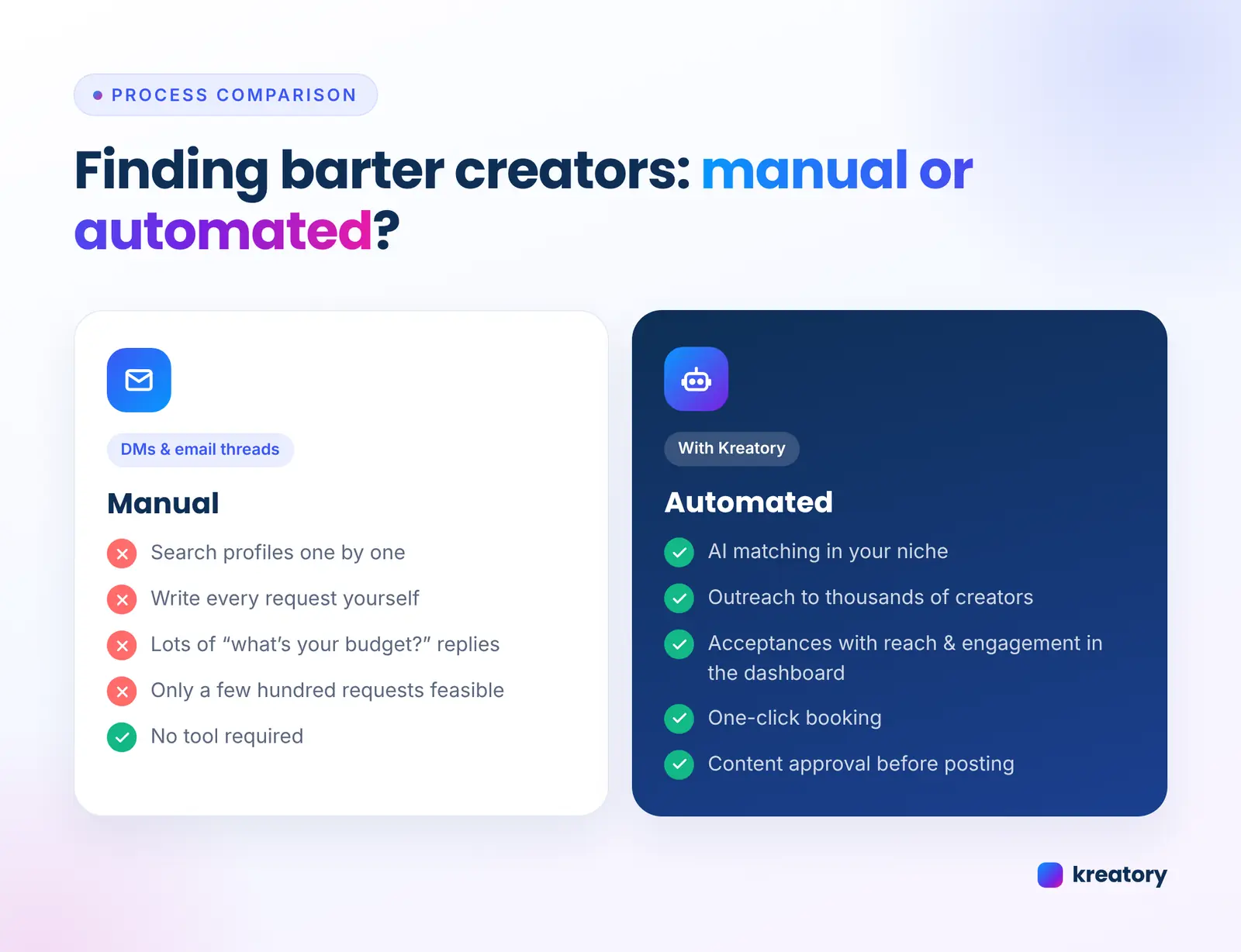
You only find influencers who accept product instead of cash by sending a lot of requests – at 2–7% acceptance you need a large base. That is hardly possible manually, but very doable with automation.
The classic approach: research 100 profiles by hand, write 100 DMs, run 60 email threads asking “What’s your budget?” – and in the end two creators say yes. That does not scale. Tips for manual research are in How to find micro-influencers.
Good results need a clear brief covering product, message and deadlines – see How to write an influencer brief. If you mainly need content for ads, also read How to find UGC creators.
Q4 is the strongest sales period of the year for e-commerce shops – with Black Friday on 27 November 2026, Cyber Monday and the Christmas season. Content that goes live beforehand reaches customers who are ready to buy.
Yes. A product given in exchange for content is consideration, so the post counts as advertising. In Germany this follows from Section 5a(4) of the Unfair Competition Act (UWG); the post must be labelled, for example with “Werbung”/“Anzeige” (ad) and the platform’s paid-partnership feature. Other countries have comparable rules.
The guidelines of the German state media authorities (die medienanstalten) offer orientation. Full details with examples are in Ad disclosure in influencer marketing. This section is not legal advice.
Want to know the barter rate in your niche, how many relevant creators our database of more than 5.4 million creators holds, and whether your product and AOV work for barter? Book a 30-minute demo call.
Prefer to get started yourself? Sign up for Kreatory and set up your first barter campaign in under 10 minutes.
A barter deal is an influencer collaboration in which the creator receives a product instead of a fee. In return, they create agreed content such as a Reel, a Story or a UGC video. The basics are covered in Barter deals with influencers.
According to Kreatory platform data (observed over six months, as of autumn 2026), around 2–7% of the influencers contacted agree to take a product instead of cash, depending on the niche. The rate depends heavily on product and niche.
Some do – but not without anything in return. In a barter deal, the product is the payment. Creators who post with nothing in return are usually customers talking about a product organically.
A barter deal costs you the cost of goods plus shipping. There is no fee. Depending on your setup, you may also have platform costs or the time you spend on research and coordination.
Barter deals work best for e-commerce shops with a product creators genuinely want, a good ratio of retail value to cost of goods, and a basket size (AOV) that carries the cost.
Yes. A product counts as consideration, so the post must be labelled as advertising. Details are in Ad disclosure in influencer marketing.

👉 Want deep insights into influencer marketing & UGC sourcing and curious about our success stories?📈