

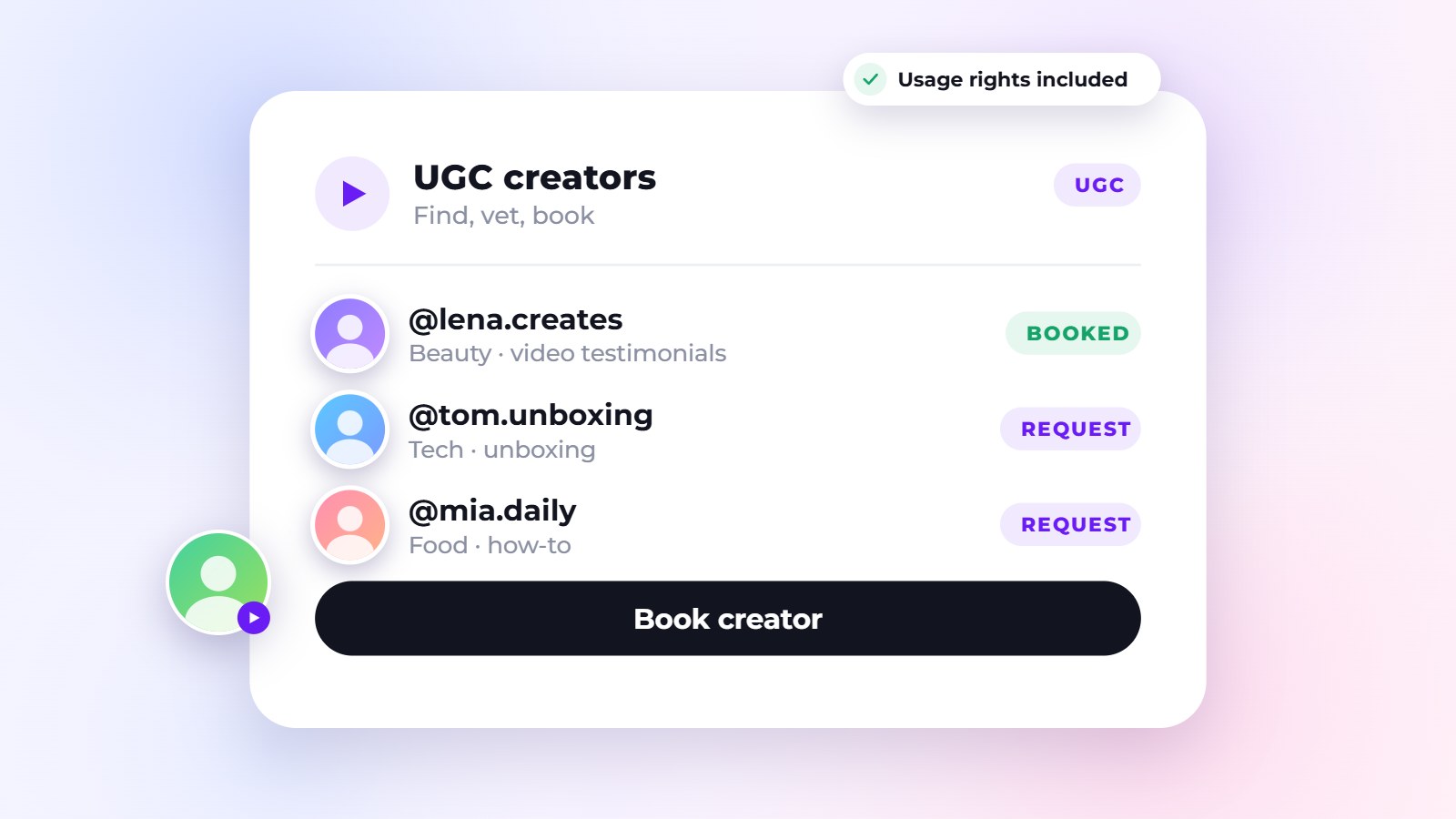
Short answer: You can find UGC creators on creator platforms with a searchable database, through hashtag research on TikTok and Instagram, or among your own customers. What matters isn’t follower count but whether someone can shoot convincing videos for your audience. With a clear brief, usage rights in writing and an approval step, booking UGC becomes predictable – and easy to scale for ads.
UGC stands for user-generated content: videos and photos that look like they came from real customers – unboxings, testimonials, tutorials, before-and-afters. A UGC creator produces this kind of content on behalf of a brand. Unlike a classic influencer post, you’re not paying for the creator’s audience; you’re paying for the content itself, which you then run on your channels, product pages or as paid ads.
We covered why it works in What is user-generated content? 3 reasons UGC works. In short: UGC looks like the native content people already scroll through, so it doesn’t scream “ad.”
Manual research works for a few videos. Once you need 20, 50 or more, coordination quickly becomes the bottleneck.
If you need UGC content for a specific country – say the US, the UK or Germany – a good video alone isn’t enough. The creator has to sound like your customers there, and the logistics have to work.
On a platform, you can filter by country and language instead of vetting profiles one by one.
Instead of finding UGC creators yourself, you can hire a UGC creator agency. It handles selection, briefing and coordination for you – but you usually pay an agency fee on top and get less direct visibility into who is picked and at what rate.
A platform is the middle ground: you keep control over creator selection and approval, while discovery, outreach and billing run automatically. An agency can make sense for one-off large projects; if you need UGC content for ads on an ongoing basis, a platform is usually more flexible. For a detailed comparison, read influencer marketing agency vs. software.
With UGC, the video’s performance matters more than the profile. Check:
Tip: ask for two or three samples in your target format. A small paid test tells you more than any portfolio.
Not every format fits every goal. These have proven themselves in practice:
Test several formats in parallel, then put your budget behind the winners.
Usage rights are the most important part of any UGC agreement – after all, you plan to run the content yourself. Get these in writing:
According to Influencer Marketing Hub, citing Aspire data, 67% of brands include usage rights in the creator’s initial contract or rate – a sensible default that avoids renegotiating later.
UGC is usually cheaper than a traditional influencer post because you’re not paying for reach. Influencer Marketing Hub reports that roughly 80% of the UGC costs in its survey fall below $500. Prices go up with video length, number of variations, raw footage and the scope of usage rights. For detailed ranges, read our article on influencer marketing costs in 2026.
For physical products, a barter deal can also work: the creator receives your product instead of – or in addition to – a fee. Our guide to barter deals with influencers explains how.
UGC ads are paid ads on Meta, TikTok or YouTube that use UGC content instead of polished commercials. Because they look like regular posts, they work especially well for hook testing and retargeting.
Performance teams don’t need one perfect video; they need lots of variations to test. To scale:
That’s what Kreatory’s UGC sourcing is built for. You set up a campaign in under 10 minutes, AI finds matching creators among more than 5.4 million and reaches out automatically. Creators send offers, you book with one click and approve videos before they go live. Payouts happen automatically, and you get one invoice from Kreatory instead of dozens. Barter deals are supported too. Plans start at €173 per month (pricing).
Want your first UGC videos within days? Sign up and launch your first UGC campaign – or watch the 90-second demo first.
No. With UGC you pay for the content, not the reach. Many strong UGC creators have small accounts but make videos that perform very well in ads.
The fastest way is a creator platform that lets you filter by country and language. Alternatively, search TikTok and Instagram for terms like “UGC creator” plus your country or niche, or reach out to happy customers.
An agency handles selection and coordination for you, usually for an extra fee. On a platform you pick creators and approve content yourself, while outreach, contracts and payouts run automatically.
If the creator posts the content on their own channel, standard disclosure rules apply. If you run it from your own ad accounts, it’s already marked as an ad. Our article on ad disclosure in influencer marketing covers the details for Germany.
It depends on your budget and testing approach. A good start is several creators with a few hook variations each, then scaling the winners.
It depends on shipping, coordination and approvals. A clear brief and automated operations shorten the process considerably.
Yes, as long as your usage rights cover it. Agree on channels, duration and editing rights in writing before you book.

👉 Want deep insights into influencer marketing & UGC sourcing and curious about our success stories?📈


